
Humanity is quietly crossing the threshold from a species that visits space to one that intends to live there.
It has been more than half a century since a human being looked back at Earth from the vicinity of the Moon. The last time was Apollo 17 in 1972. In the decades since, we have sent robots, telescopes and satellites deeper and deeper into the cosmos, but we ourselves stayed home. That is about to change, and the shift happening right now is bigger than most people realise.
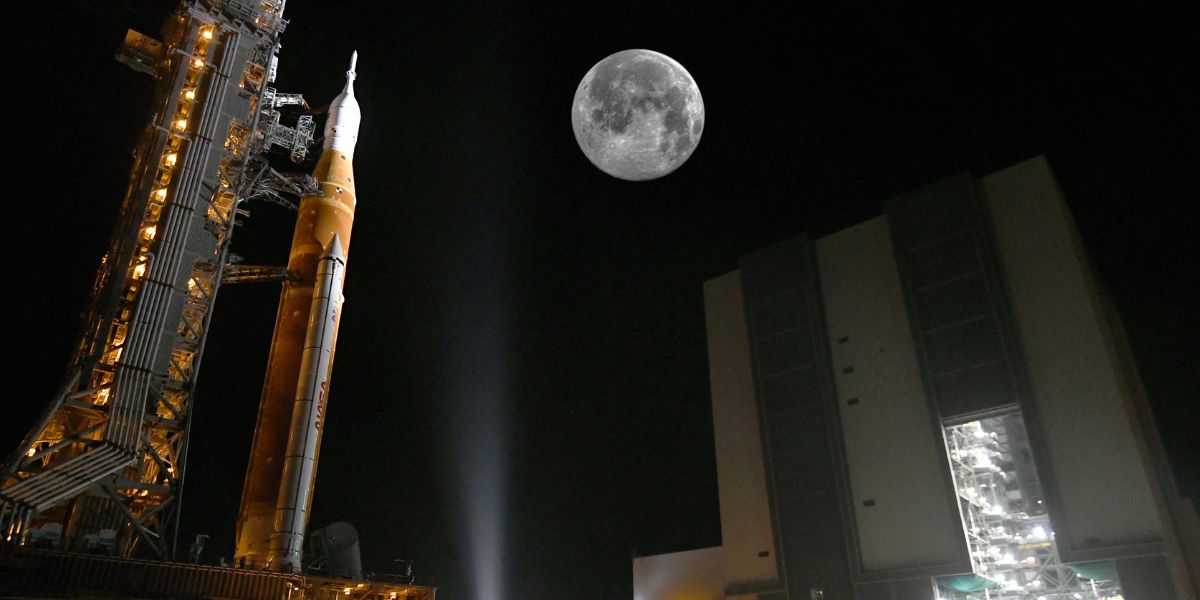
A six-day launch window opens on April 1 from NASA’s Kennedy Space Center in Florida for Artemis II, a mission that will carry four astronauts on a 10-day loop around the Moon and back. Among them will be the first woman, first person of colour and first non-American citizen to travel beyond low Earth orbit. It is, by itself, a significant milestone. But what happened in the days before that launch window makes it even more remarkable.
On March 24, NASA Administrator Jared Isaacman stood before contractors, international partners and members of Congress and laid out something far more ambitious than a flyby. The agency unveiled a major overhaul of its Moon and Mars strategy, scrapping plans for a space station in lunar orbit and instead committing $20 billion over seven years to build a base on the Moon’s surface. The Lunar Gateway, a long-planned orbital outpost, has been shelved. Its components will be repurposed for use on the ground. In its place, NASA wants habitats, pressurised rovers, communications infrastructure and, eventually, nuclear power plants on the lunar south pole.
The word Isaacman kept returning to was “sustained.” Not a visit. Not a photo opportunity. A permanent human foothold. NASA plans to build the base in three stages, starting with more frequent astronaut and cargo flights, then semi-habitable infrastructure, then heavier equipment to support a continuous human presence. The goal, as Isaacman framed it, is not flags and footprints. It is civilisation’s first address beyond Earth.
And it does not stop at the Moon. NASA also disclosed plans to launch a spacecraft called Space Reactor 1 Freedom to Mars before the end of 2028, powered by a nuclear fission reactor, a technology that has never been used for interplanetary travel. Upon arrival, it would deploy small helicopters to explore the Martian surface, building on the success of the Ingenuity drone that made history in 2021 as the first powered aircraft to fly on another planet. NASA described the mission as a major step in bringing nuclear power and propulsion from the laboratory to deep space.
There is, of course, a geopolitical engine driving all of this. China has steadily built a human space programme with goals that include landing astronauts on the Moon by 2030, and its track record gives those ambitions real credibility. In 2024, a Chinese robotic lander returned soil samples from the far side of the Moon, a feat no other nation has managed. Former NASA officials have warned that whoever reaches the lunar surface first could shape the rules and norms that govern activity in space for decades to come. Isaacman, for his part, has been blunt about the stakes without naming names, referring to a rival challenging American leadership in the high ground of space.
But strip away the flag-waving and the budget figures and something more interesting emerges. For most of human existence, the idea of living anywhere other than Earth has been the stuff of mythology and, later, science fiction. The Apollo programme proved it was physically possible to reach the Moon but never attempted to stay. What is happening now is qualitatively different. When an agency commits to nuclear reactors on the lunar surface and phased construction of permanent habitats, it is no longer planning an expedition. It is planning infrastructure. It is making the same kind of bet that led to the first roads, aqueducts and railways, investments that only make sense if you intend to stick around.
The philosophical implications are hard to overstate. Oxford philosopher Toby Ord has argued that humans face a roughly one-in-six chance of extinction this century, from risks ranging from asteroid impacts to engineered pandemics. For a growing number of thinkers, spreading human civilisation beyond a single planet is not optimism but basic insurance. Others push back, arguing that the billions spent on lunar concrete would be better used solving problems here at home, or that exporting human settlement to new worlds risks replicating the same inequalities and environmental damage we have yet to fix on this one.
Both arguments have force. But what is new this week is that the question has shifted from “should we?” to “how fast can we?” The Planetary Society estimates NASA will have spent roughly $107 billion on return-to-the-Moon plans through 2026 in inflation-adjusted dollars, a figure inflated by two decades of shifting political priorities and programme restarts under successive administrations. That messy history is itself a lesson: grand visions need sustained commitment, and space exploration has suffered every time a new president has redrawn the map.
Whether this particular plan survives the next election cycle is an open question. What is harder to undo is the momentum. Private companies such as SpaceX and Blue Origin are racing to build lunar landers. International partners in Japan, Canada and Europe are repositioning around the new architecture. NASA and the US Department of Energy have signed a memorandum of understanding to develop a lunar surface nuclear reactor by 2030. The industrial base is activating whether or not the political winds shift.
When the four Artemis II astronauts swing around the far side of the Moon next week, they will see something no human has witnessed in more than 50 years: the whole of Earth, hanging in blackness, small enough to cover with a thumb. Every astronaut who has had that experience describes it as transformative, a sudden, visceral understanding that all of human life exists on a single fragile rock. It is called the Overview Effect, and it tends to make people think long-term.
That might be the most important thing about this moment. Not the $20 billion, not the nuclear reactors, not the geopolitical chess match with Beijing. It is the possibility that, for the first time, we are building something in space that is meant to outlast any single mission, any single president, any single generation. Whether that makes us wise or reckless is a debate worth having. But the concrete is being poured.